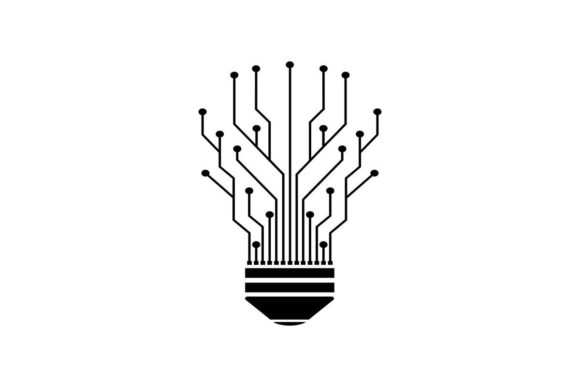
Exploring the Circuit Board Line Bulb Concept Design
There is a specific kind of visual tension that happens when you merge organic inspiration with rigid technological structure. The Circuit Board Line Bulb Concept Design Illustration captures this perfectly. It isn't just a vector graphic; it’s a narrative about where light meets logic. You have the universal symbol of an idea—the lightbulb—but instead of a simple glass envelope and filament, it is constructed from the intricate pathways of a PCB (Printed Circuit Board). This design asset speaks to the modern condition of creativity: it is rarely just a spark anymore, but rather a complex system of processing, wiring, and engineering that brings that spark to life.
Visually, this illustration style relies heavily on line weight and negative space. The aesthetic is clean, often monochromatic, mimicking the look of technical drafting or the copper traces on a motherboard. It possesses a "blueprint" personality—structured, intelligent, and precise. However, because the subject is a lightbulb, it retains a sense of warmth and potential. It suggests that innovation is occurring. For designers and content creators, this file is a bridge between the abstract concept of "thinking" and the tangible reality of "building." It is a premium design asset that fits seamlessly into modern typography trends where minimalism meets technical complexity.
Practical Applications: From Web Graphics to Print Media
The versatility of the Circuit Board Line Bulb Concept Design Illustration is one of its strongest selling points. Because the asset is provided in both EPS and JPG formats, you have flexibility in how you manipulate it. The EPS vector file is crucial for scalability. You can stretch this design to cover the back of a trade show banner or shrink it down for a favicon without losing the crispness of those intricate circuit lines. This makes it an ideal choice for web design headers, particularly for tech startups, engineering blogs, or SaaS companies that want to visualize "connectivity" or "innovation" without using generic stock photography.
On the print side, the application is just as broad. Imagine this illustration as the centerpiece of a packaging design for a new electronic gadget or a DIY electronics kit. It instantly communicates the contents without needing a single word of text. It also works exceptionally well for editorial design. If you are a publisher working on a magazine cover story regarding Artificial Intelligence or the future of electricity, this line art provides a sophisticated, high-contrast background that allows for strong typography overlays. It creates depth without visual clutter, allowing your serif font or sans serif font headers to pop against the intricate background.
For social media graphics, particularly on platforms like LinkedIn or Instagram where tech communities thrive, this illustration serves as a scroll-stopper. It is abstract enough to be artistic but specific enough to be understood instantly. Entrepreneurs can use it in pitch decks to visualize the "lightbulb moment" during their presentations. Crafters and hobbyists might even find value in it for sublimation printing on mugs or t-shirts for the maker community. The file is a creative font for the eyes—communicating a complex language of circuits through a familiar symbol.
Strategic Branding and Visual Hierarchy
Choosing a visual asset like the Circuit Board Line Bulb Concept Design Illustration is a strategic decision that influences brand identity. When you incorporate this style into your marketing materials, you are positioning your brand as thoughtful, technical, and forward-thinking. It moves your visual hierarchy away from playful, organic doodles and toward a more structured, professional aesthetic. This is particularly useful for B2B companies or service providers in the IT sector. The illustration suggests that your ideas are not just fleeting thoughts, but engineered solutions.
Consistency is key in branding, and this asset helps achieve that. Because it is a "line" concept, it pairs beautifully with modern, geometric typefaces. You can easily create a cohesive look by matching the line weight of the illustration with the stroke weight of your chosen display font. For example, pairing this illustration with a bold, industrial sans serif font reinforces the tech aspect, while pairing it with a delicate script font creates an interesting contrast between human touch and machine precision. This interplay enhances audience engagement because it offers a richer visual texture than a flat image would.
Integration and Design Best Practices
To get the most out of this asset, you need to consider how it interacts with your other design assets. Since the circuit board lines are likely fine and detailed, readability is paramount. You should avoid placing body text directly over the densest parts of the illustration. Instead, use the illustration as a focal point or a background element with lowered opacity, ensuring that your primary message remains legible.
When evaluating the fit for your project, consider the "personality" of the work. If you are designing a flyer for a local community garden, this illustration might feel too cold or industrial. However, if you are branding a coding bootcamp, a smart home installation service, or a science podcast, it is the perfect fit. It acts as a visual metaphor for the "how" behind the "what."
Finally, remember that while the JPG is great for quick mockups or digital posts, the EPS file is where the real value lies for professional designers. It allows you to deconstruct the illustration. You could isolate just the filament, change the color of the circuit traces to match your brand’s hex codes, or integrate the bulb into a larger typographic lockup. This level of customization is what separates amateur graphics from professional logo design and branding materials. By treating the Circuit Board Line Bulb Concept Design Illustration not just as a picture, but as a modular component of your visual system, you unlock a higher level of creative potential for your projects.