Bringing Ocean Magic to Your Design Projects
There’s a specific kind of enchantment that comes with the ocean—deep blues, shimmering greens, and the mythical allure of mermaids. If you’ve ever tried to capture that fantasy in a design project, you know how difficult it is to find assets that feel genuinely magical rather than childish or tacky. This is where Mermaid's Tail Clipart steps in, offering a solution that bridges the gap between whimsical fantasy and professional-grade design work. It isn't just a collection of random shapes; it is a curated set of 18 high-resolution PNG files designed to inject a sense of underwater elegance into your creative workflow.
For designers, entrepreneurs, and content creators, the struggle often lies in finding assets that are versatile enough for both digital screens and physical prints. This collection solves that problem by providing 300dpi files with transparent backgrounds. This technical foundation is crucial because it ensures that whether you are printing a large-scale party banner or scaling the image down for a mobile social media icon, the integrity of the image remains intact. The intricate details of the scales and the shimmering glitter accents do not pixelate or blur, maintaining a level of professionalism that is essential for commercial use.
The Anatomy of the Collection: Style and Personality
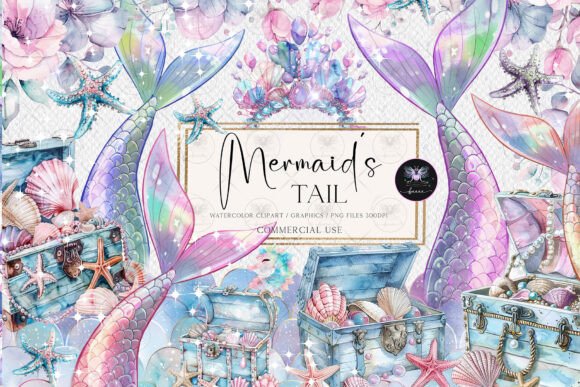
When we talk about the "personality" of a design asset, we are looking at the emotional response it triggers. The Mermaid's Tail Clipart collection leans heavily into a style that is vibrant, dynamic, and texturally rich. The illustrations move beyond simple flat vector art; they incorporate depth through shading and highlights that mimic the way light interacts with water and scales.
Visually, the collection offers variety. You aren't stuck with a single silhouette. The set includes different tail styles—some with elegant, flowing fins perfect for a sophisticated, ethereal look, and others with more structured, shimmering scales that command attention. The color palette is versatile, featuring gradients that transition from deep ocean blues to sunset corals and seafoam greens. This variety allows you to select a tail that matches the specific mood of your project, whether it is a mysterious midnight theme or a bright, cheerful beach party.
From a design strategy perspective, these assets function similarly to a display font. Just as a premium font can set the tone for a brand identity, a strong visual element like a detailed mermaid tail can serve as the anchor for your layout. It draws the eye and establishes the "underwater fantasy" theme immediately, allowing the rest of your design elements—typography, background textures, and layout—to build upon that foundation.
Strategic Applications for Modern Creatives
Understanding where to deploy these assets is key to maximizing their value. The versatility of the Mermaid's Tail Clipart makes it a powerful tool across various mediums, but context is everything. Here is how different professionals can leverage this collection effectively:
Digital Marketing and Social Media
In the fast-paced world of social media graphics, stopping the scroll is the primary objective. A vibrant, high-contrast mermaid tail can be used as a background element or a focal point in Instagram stories, Pinterest pins, or Facebook headers. For content creators in the beauty, travel, or lifestyle niches, these tails can be used to frame text overlays, creating a visual hierarchy that guides the viewer's eye from the image to the call-to-action. Because the files have transparent backgrounds, they layer seamlessly over photographs or solid color blocks, allowing for complex web design compositions without the hassle of clipping masks.
Publishing and Editorial Design
If you are working on editorial design for a children’s book, a fantasy novel cover, or a magazine feature, the quality of your imagery reflects the quality of the content. Using these clipart elements can break up text-heavy layouts. For instance, a small, scaled tail in the corner of a page can act as a decorative divider, adding a thematic touch without overwhelming the typography. This is particularly useful when you want to maintain a cohesive brand identity for a series of publications.
Physical Products and Packaging
For small business owners involved in packaging design, the 300dpi resolution is non-negotiable. This collection is print-ready, meaning you can use it for stickers, labels, and party decor without worrying about print quality degradation. Imagine a bakery creating a line of "Mermaid Lagoon" cupcakes; the tail clipart can be printed on edible paper or used on the box design. The intricate details of the fins and scales add a tactile quality to the visual design, suggesting a higher value product.
Integrating Clipart with Typography and Layout
A common mistake in design is treating illustrations and typography as separate entities. To create a cohesive brand identity, they must converse with each other. When using the Mermaid's Tail Clipart, consider the typeface you pair it with.
Because the tails are organic, flowing, and intricate, they pair exceptionally well with a sans serif font that has clean lines. The contrast between the detailed illustration and the minimalist text creates a balanced visual hierarchy. Alternatively, if you are going for a more romantic, high-fashion look, pairing the clipart with a script font or a handwritten font can enhance the elegance of the fins. However, readability is paramount. Ensure that your text remains legible against the busy background of the scales. Using a solid color block or a slight drop shadow behind your modern typography can help separate the message from the imagery.
When it comes to logo design, using clipart can be tricky due to trademarking issues, but for temporary campaigns, event branding, or personal projects, these tails can be the centerpiece. They provide a creative font style of visual language that speaks directly to a specific audience—those who love fantasy, summer, and the ocean.
Practical Tips for Selection and Usage
Before you finalize your project, it is worth taking a moment to evaluate the fit of the asset. Not every mermaid tail will work for every project. A tail with heavy glitter accents might look fantastic on a birthday invitation but could be too busy for a professional brochure. Conversely, a sleek, single-tone tail might be perfect for a subtle watermark on a menu.
Here is a practical checklist for working with this collection:
- Evaluate the Color Palette: Look at the existing colors in your project. Do the tail gradients complement your primary and secondary brand colors? If not, remember that PNGs can often be color-adjusted in software like Photoshop or Canva, though the original vibrant tones are usually the strongest.
- Check the Orientation: The collection offers various poses. Ensure the flow of the tail matches the direction of your text or the focal point of your layout. A tail curving to the left draws the eye leftward, which can be useful for leading a viewer toward a headline.
- Review Commercial Licensing: This is the most critical step for entrepreneurs. Ensure you understand the licensing terms. Most commercial font and asset licenses allow for use on end products (like t-shirts or mugs) but restrict resale of the raw digital file. Always verify this to protect your business.
- Test at Scale: Zoom in and out. Does the detail hold up when printed on a large poster? Does it remain clear when shrunk down for a favicon or a small sticker? The high-resolution nature of this set usually handles scaling well, but testing prevents surprises.
Ultimately, the goal of using Mermaid's Tail Clipart is to evoke a specific emotion—wonder, fun, and fantasy. By treating these assets with the same strategic care you would apply to choosing a serif font or a color palette, you elevate your project from a simple craft to a polished piece of visual communication. Whether you are designing a one-off party invite or building a cohesive visual identity for a summer campaign, these tails provide the texture, color, and magic needed to make a splash.